Summary (Click to enlarge images, opens new window).
I bought this tent to replace my ancient Saunders Satellite, which was no more than a glorified bivvy, though a techno-marvel in its day. At ~1.2kg, the Solar Comp is a great option for those who don't want to lug unnecessary weight around, and want more stability than a tunnel can offer. Stretched out fully
inside, with my hands raised above my head, I can just touch the ends of the inner; plenty of space for me (5' 6") and my 48-litre pack. The
porch is plenty big enough for poles, boots, stove, and my half-empty pack (minus tent/sleeping bag/mat), but not a jumbo rucksack, and you wouldn't want to cook in it with the door closed.
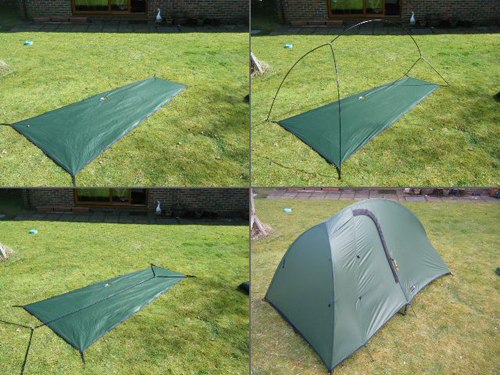
Pitching is easy, even in a wind (which was still blowing some when I took these photos), and takes less than five minutes. The full technical spec for this tent is
here.
Pack Size & WeightSold as 1055g, the pack was 1100g on my scales, including the repair kit. Decent
pegs (no spares) brought the weight up to 1160g. Total weight including the
footprint, decent pegs (+ two spares), and pole repair sleeve (but without fabric squares) was 1318g.

 In the bag (left), and optional extras: guys, footprint and sturdier pegs (right)Pitching
The Solar Comp has three pitching configurations: inner + outer, inner only, or outer +
footprint. The two front poles and the ridge come as one, and the tail-end triangle as another. The pole ends clip into eyelets on tags at the corners of the inner (which also has pegging points), the inner clips to to poles, and the fly goes over. Fantastically quick to pitch. The fly is attached by eyelets too, and has four pegging points. There also are five guy-points, but only three guys supplied, and there aren't enough pegs to go round if you've pegged down the inner - which you need to do in a wind. Nominally, the inner is pitched first, but if you use a
footprint, you can pitch the flysheet first (though you might want to rearrange the eyelets - which is hard on cold hands).

 Inner only (left), outer + footprint only (right)Pegs
The supplied pegs are the 2g titanium needles (see "in the bag" photo above), with yellow tops so you can lose them amongst the grass/lichen/bracken. Five of the seven fly/guy pegs came out at some time or another during the night, despite being pitched on grass (though admittedly the three windward pegs popped when a garden chair blew into the tent). They're okay for pegging down the inner while pitching, but not much else. I'm not the first to change them (below left).

 Supplied pegs, bottom; replacements for the fly/guys, middle/top (left), Velcro pole tabs inside (right)Outer Door
The door has plenty of
ventilation options, including a clip/strap setup (see ventilation photos, below), but the clip is on the outside (to avoid run-off into the inner), making it awkward to reach, and it's hard to operate with cold hands. I'd have liked to see a clip on the inside too. There is another clip at the bottom to secure the zip when closed - and this can be used to peg the fly closer to the ground (see ventilation photos, below). The zip comes under some tension at the corner while opening/closing, but has a storm flap, and is double ended. Don't reply on being able to make an awning with a hiking pole. The door opens tailward and, assuming you've pitched tail into wind, it would only offer protection in rain with no wind. There is only one toggle tie, meaning that the top of the door hangs/flaps when it's tied back.

 Outside door clip, difficult for cold hands (left), and how to get drips on your sleeping bag (right)The Porch
The porch is very small, but I found the space useful. I could stow my 48-litre pack, boots, stove and poles (below left). While you wouldn't want to cook, as is, with the outer door closed, it's simple to unhook and fold back the end of the inner to make more space (below right). The flysheet door zip is double ended for
ventilation.

 Places to store a 48-litre pack (left), and extra space made by unclipping & folding back the inner (right)Inner Door
The inner door is all mesh (below left), so you don't feel too enclosed, but it was draughty in the strong wind of the first night. If you pull the wall down only an inch, you have a direct sight-line out from the sleeping position, and the wind has a direct line in (below right). With a lighter wind on the second night, I didn't notice a draught at all.

 All mesh inner door (left), and don't let your sleeping mat pull the side wall down (right)Inside
The inner tent is yellow, which gives a nice colour inside, and is easy on the eye. There is space for me (5' 6") to stretch my arms above my head and only just be able to touch the end with my toes touching the other end. There is ample headroom too. There is plenty of space for my 48-litre pack to lie sideays at the head end, with room to spare

 Inside views (left), and the head end (right)Ventilation
The fly sits quite high, meaning that there is a fair draught underneath in a strong wind (see inner door photos, above). This is great for ventilation, but draughty with the full-mesh inner door. (It is possible to peg the fly lower down/closer in (below left), but this reduces the size of the porch.) There are mesh panels at the top of each end of the inner (inside photos, above). The outer door has a double-ended zip, and a buckle for clipping it partly open at the bottom (below, right). Ventilation just wasn't a problem, even on my second night when the wind had dropped there was only the slightest dampness on the inside of the flysheet. On a hotter, dryer, night, you could simply remove the flysheet, as the inner can stand alone if necessary.

 Using the clip at the bottom of the zip to peg the fly to the ground (left), and ventilation options (right)Footprint
There are two footprints available for this tent: 130g (standard weight) for £40, or 60g (fastpack) for £120. Both are made of material "the same as the flysheet," (rather oddly, they won't let on the weave size), so I'm not quite sure where the different weight/price comes in. I ordered the 130g version. It attaches to the poles with the same tab/eyelet system, and I was expecting it to fit tightly, but in fact it's oversize and flaps about a bit. The bag it comes in is unnecessarily tight (the words condom and flaccid will give you an idea) so I'll be keeping the footprint in the main sack, and using its bag for pegs/guys, etc. (the peg pocket in the pole bag is too small for my extras).

 The footprint, and optional extra (left), and the fly and footprint only (right)Stability
As with any tent, it's worth knowing if the wind is expected to veer or back during the night, and pitch accordingly, but the SC handled a side wind perfectly. In addition, a garden chair blew into a tail-end corner during the night, shifting the poles and popping out three pegs. I woke up to find the door side of the tent in my face (in a gale); but with the aid of a handy hiking-stick (to push the pole back into place), I could re-peg without getting out of bed. Chairs notwithstanding, I found the structure totally stable. I wasn't aware of anything other than the gentlest flapping during the strongest gusts (30mph+).
WaterproofnessI had both torrential rain and 4mm hailstones during the first night and, apart from a very small amount of rain blowing under the flysheet and into the porch, everything stayed dry. (Gear stored in the porch will likely get a dusting on a wet and windy night.) As I had little/no condensation, even the fly blowing against the inner during the chair incident (see
Stability) caused no problem.
Good Features:1055g on the box, 1100g on my scales, 1150-1200g with decent pegs.
very quick to pitch (<5mins)
super quick to re-pitch (<30secs)
5000mm groundsheet, 3000mm fly
yellow inner - easy on the eyes!
small pack size (can be packed horizontally)
stable: survived 30mph+ gusts with no flapping to speak of.
waterproof: survived torrential rain & hail with no effect
3 pitch configurations: inner + outer, inner only, outer +
footprint (not included)
stand alone (inner as is, or outer +
footprint + dead guys).
ceiling loop and pocket inside (see inside photos)
Virtually no condensation (*see also poor features)
Neutral Features (depending on your point of view)
Small
porch: less
weight, but less space.
The whole tent is small - but this is perfect for folk who don't want extra space/weight.
Full mesh inner door is draughty in windy conditions, but great for
ventilation and a feeling of space.
Poor FeaturesPegs don't hold in the wind, even in my garden.
(I've bought some
11g v-section pegs instead - see also right-hand photo under
Pegs)
5 guying points, only 3 guys supplied...WTF?
14 pegging points, only 9 pegs supplied...ditto.
Care is needed when opening the
outer door in the wet, so water doesn't trickle on/in to the inner.
Elastic on the door ties are too long, so they don't hold very well.
Only one toggle tie per door, so the fabric hangs down when tied back.
Door clip is outside, and too small/stiff for cold fingers.
*A bit draughty in strong wind - though this can be minimised with careful pitching.
I'm actually really pleased with the Solar Comp. My gripes are only minor and/or easily rectified, so I wholeheartedly recommend this tent.
Please leave feedback/questions about this tent/review via the comments' link, just below. Thanks!

 A lightweight (83g), 50-lumen, 35m, 140h, water-resistant, multi-mode headtorch with a 4* listing in the 2010 Trail Gear Guide. I've not yet tested it in the field, but I've made several trips to the pub! (The manufacturer's spec is here.)
 Lightweight: only 83g including batteries




 Posts
Posts

